How Does i-loadzone Simplify Cross-Platform Software and IT Troubleshooting?
Very few households or small offices run exclusively on one type of device anymore. A typical creator, student, or office coordinator might write reports on a Windows desktop at work, edit slides on a MacBook while traveling, transfer scanned receipts from an Android phone, and rely on a shared wireless inkjet printer tucked beside the desk. When everything communicates smoothly, technology feels invisible. Yet the moment a print spooler freezes, an archive fails to extract, or a macOS utility behaves differently from its Windows counterpart, productivity grinds to a halt.
The real challenge behind multi-device computing is rarely a shortage of applications; it is the lack of calm, cross-platform guidance that explains how utilities, drivers, mobile apps, and peripheral maintenance routines fit together. Many support blogs focus strictly on enterprise server infrastructure while ignoring practical everyday hurdles like cleaning stalled printer queues, verifying installer integrity, organizing portable USB toolkits, or matching software builds to specific operating system versions.
This comprehensive technical guide explores how organized software references simplify cross-platform workflows. From comparing Windows and macOS utility architecture to managing Android companion apps, servicing office printers safely, inspecting checksums, and establishing repeatable IT troubleshooting habits, every section translates technical maintenance into straightforward steps anyone can follow.
Navigating Mixed Windows, macOS, and Android Environments
Operating systems approach file storage, hardware permissions, and software packaging in fundamentally different ways. Understanding those underlying differences prevents frustrating trial-and-error mistakes when moving files or replicating workflows across computers and phones.
On Windows desktops, applications commonly integrate directly with File Explorer context menus, system-wide registry settings, and modular runtime libraries. By contrast, macOS bundles applications inside self-contained app packages governed by strict Gatekeeper signing checks and sandboxed folder permissions, while Android isolates each mobile app inside its own sandboxed user profile while exposing shared media and document directories through scoped storage APIs.
Bridging File Formats Across Different Operating Systems
Because teams constantly exchange assets between PCs, Macs, and mobile phones, choosing universal file formats prevents unnecessary conversion headaches. Storing working notes in clean UTF-8 Markdown or plain text ensures zero character corruption across Notepad, macOS TextEdit, and Android editors. Archiving multi-file project bundles in standard ZIP containers—rather than platform-specific compression formats—lets any recipient unpack folders natively without hunting for extra extractors.
Media teams benefit equally from standardizing containers. Exporting finished screen walkthroughs in MP4 with H.264 video and AAC stereo audio guarantees immediate playback across Windows Media Player, QuickTime on macOS, and mobile browsers without requiring specialized codec packs on the viewer’s machine.
Choosing Universal Cloud and Local Sync Boundaries
Cross-platform users frequently install two or three cloud drive clients without defining clear folder boundaries, leading to conflicting duplicate files and sluggish background indexing. A cleaner pattern separates live scratch work from finalized shared archives. Keep raw video recordings, temporary installer extractions, and active audio project caches strictly inside non-synced local project folders so operating system disk I/O stays quiet during heavy tasks. Once a document, podcast master, or spreadsheet reaches final form, move or copy it into your designated cross-platform sync directory so laptops, tablets, and phones immediately receive clean, finalized revisions without upload storms.
Consistent folder naming amplifies that clarity. Adopting lowercase hyphenated project names paired with standard ISO dates—such as year-month-day prefixes—guarantees chronological sorting works identically across Windows File Explorer, macOS Finder, and Android file managers without awkward character encoding errors.
Essential Windows and macOS Utilities for Everyday Productivity
Even modern operating systems ship with basic default utilities that leave ample room for workflow improvement. Adding a concise handful of well-tested desktop tools transforms repetitive daily chores into rapid keyboard habits while keeping background memory usage modest.
Plain-Text Editors, Diff Tools, and Batch Renamers
Every computer benefits from a fast tabbed text editor capable of handling large log files, configuration scripts, CSV exports, and HTML snippets without inserting invisible formatting codes. When comparing two versions of a configuration file or checking why a script stopped working, side-by-side diff viewers highlight exact line changes instantaneously instead of forcing manual eye-scanning across hundreds of rows.
Batch file renamers offer similar time savings for photographers, podcasters, and office clerks. Rather than clicking dozens of scanned invoices one by one to append dates or sequence numbers, rule-based renamers preview every filename transformation cleanly before committing a single disk write.
Archive Managers and Disk Space Visualizers
When boot drives fill unexpectedly, guessing which hidden folder grew to forty gigabytes wastes precious time. Visual disk space analyzers scan partitions in seconds and display proportional folder trees so you immediately spot forgotten installer caches, orphaned video renders, or duplicated backup zips. Paired with a dependable archive utility that verifies compressed folder integrity prior to extraction, storage hygiene stays calm and predictable.
Comparing Utility Priorities Across Platforms
Understanding which maintenance tasks belong to native system tools versus specialized utilities keeps every machine agile without unnecessary background clutter.
| Workflow Area | Windows Focus | macOS Focus | Mobile / Companion Role |
|---|---|---|---|
| Text & Config Editing | Tabbed UTF-8 code and log editors | Lightweight developer editors and terminal tools | Quick Markdown scratchpads synced cleanly |
| Storage Hygiene | DriverStore & cache cleanup with visual tree maps | Application leftover cleanup and disk snapshots | Clearing offline media caches and duplicate downloads |
| Hardware & Printing | WHQL driver matching and spooler diagnostics | AirPrint and vendor CUPS queue verification | Wireless document scanning and mobile print jobs |
| File Transfers | Checksum verification and archive testing | Universal ZIP packaging without resource fork clutter | Direct LAN transfers avoiding compressed chat uploads |
Audio, Video, and Document Creators Across Desktop Platforms
Creative work places unique demands on desktop utilities because multimedia editors interact closely with graphics memory, audio routing drivers, and high-throughput disk storage. Whether recording spoken tutorials on a Windows laptop or assembling clean vector graphics on macOS, understanding which software features matter most prevents wasted rendering time and abrupt timeline freezes.
Matching Media Workflows to Mid-Range Hardware
Many independent educators and solo marketers assume complex workstation suites are mandatory for everyday audio cleanup or screen tutorial editing. In reality, mid-range laptops with eight to sixteen gigabytes of RAM excel when paired with focused, purpose-built media applications. Lightweight audio editors trim background room hum, apply gentle loudness compression, and export crisp voice tracks in seconds without consuming heavy background services. Likewise, streamlined video cutters and format converters handle clip trimming, audio extraction, and web bitrate optimization far faster than massive multi-layer studio timelines when simple edits are all you need.
Document creators enjoy similar wins by pairing clean PDF editors with reliable batch format converters. Splitting oversized scan packets, adding legible bookmarks, compressing embedded high-DPI images before email delivery, and converting structured spreadsheets cleanly into presentation handouts keeps office workflows flowing across Windows and Mac desks effortlessly.
Optimizing Font Libraries and Language Packs Across Systems
Designers and office teams sharing presentation decks between Windows and macOS frequently run into unexpected line wraps or missing symbol glyphs caused by mismatched system fonts. Installing thousands of decorative typefaces slows down document editors and graphic toolkits on every launch. Keeping a tidy core library of cross-platform open-source font families—or embedding subset fonts inside exported PDF deliverables—ensures slide layouts, brochures, and invoices look identical regardless of which computer opens them. Similarly, pruning unused regional keyboard layouts and speech packs keeps desktop input switching fast and predictable.
Android Companion Apps and Mobile File Management
Smartphones are no longer passive notification screens; they routinely act as pocket document scanners, portable voice recorders, two-factor authenticators, and wireless transfer bridges for desktop computers. Treating Android app selection with the same discipline applied to desktop utilities prevents battery drain and storage fragmentation.
Keeping Mobile Storage Organized and Transfer-Ready
Mobile messengers automatically downscale photographs and clutter gallery folders with temporary thumbnails. Dedicated mobile file managers paired with local Wi-Fi transfer utilities let you move full-resolution camera clips, raw voice recordings, and scanned PDFs straight to your Windows or Mac desktop over your home router at full local speed—skipping slow cloud round-trips and preserving original metadata.
Before installing utility apps on Android, checking requested permissions carefully protects privacy and battery life. A simple PDF viewer or document scanner has zero legitimate reason to request background location tracking or constant contact-list access. Keeping your mobile drawer streamlined to lean, well-reviewed utilities ensures phones stay responsive years after purchase.
Verifying App Packages and Compatibility Versions
Android spans dozens of processor architectures and operating system builds, from older phones running Android 10 to modern flagship tablets on the latest releases. Matching minimum API compatibility, processor ABI targets such as arm64-v8a, and clean digital signatures ensures companion apps install cleanly without crashing on startup or breaking notification channels.
Printer Servicing, Peripheral Maintenance, and Office Hardware Care
Few office gadgets test human patience faster than an ink-tank or laser printer refusing to print five minutes before a meeting. Many households replace perfectly healthy hardware simply because they misunderstand basic printer maintenance counters, print spooler queues, or clogged printhead nozzles.
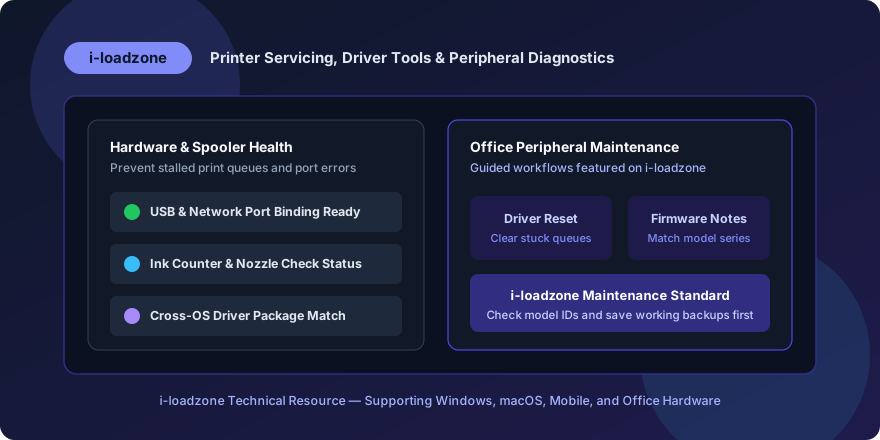
Clearing Stalled Print Spoolers and Port Conflicts
On Windows workstations, failed print jobs frequently lock the Print Spooler service in an endless retry loop, blocking every subsequent document sent from Word or a PDF reader. Restarting the Windows Print Spooler service and clearing orphaned `.SPL` and `.SHD` queue files inside the system spool directory resolves stuck queues cleanly within thirty seconds without reinstalling the printer itself.
Networked printers present a separate quirk when home routers assign dynamic IP addresses. If a wireless printer reboots after a power flicker and receives a new local address, Windows WSD ports often lose contact. Assigning a static DHCP reservation inside your router settings—or binding the printer via its fixed local IP TCP/IP port—eliminates "Printer Offline" errors permanently.
Nozzle Checks, Waste Ink Pads, and Preventive Care
Inkjet printers rely on microscopic nozzles that gradually dry out if left unused for weeks. Printing a small color test page once every ten days keeps ink flowing gently without resorting to repeated deep-cleaning cycles that waste ink reserves and saturate internal maintenance absorber pads prematurely. Whenever servicing waste ink counters or running manufacturer maintenance utilities on specific office printer models, confirming the exact model number and physical condition of internal ink pads prevents messy overflows and keeps desks clean.
Managing Scanner Drivers, WIA Interfaces, and USB Hubs
All-in-one office printers frequently print reliably while suddenly failing to send scanned pages back to the desktop. On Windows, scanning depends on Windows Image Acquisition (WIA) services or manufacturer TWAIN drivers communicating smoothly over local ports. When scanning stalls after a major OS update, checking whether the WIA service is running, re-enabling inbound firewall rules on private home networks, and avoiding unpowered multi-port USB hubs restores reliable document scanning within minutes. Connecting multifunctional printers and external audio interfaces directly to rear motherboard USB ports—rather than daisy-chained passive hubs—prevents voltage drops and erratic device disconnects.
Structured IT Troubleshooting When Software Stops Cooperating
Seasoned IT technicians rarely solve tricky computer bugs through guesswork or immediate operating system wipes. Instead, they isolate variables systematically—moving from the simplest external symptom inward toward logs, permissions, and system services. Anyone can adopt that exact structured mindset at home.
Isolating Application Crashes From System-Wide Faults
When a program suddenly freezes or refuses to launch, start by testing three simple checkpoints:
- Check Event Viewer or Crash Logs: Windows Event Viewer’s Application log frequently records the exact faulting DLL module or missing runtime library responsible for an immediate exit on launch.
- Test Under a Clean Local User Profile: Creating or switching to a secondary local Windows or Mac profile immediately reveals whether a crash stems from corrupted per-user AppData caches rather than a broken system binary.
- Verify Required Runtimes and Frameworks: Many desktop utilities depend on specific Visual C++ Redistributable packages or .NET Desktop Runtimes; confirming matching x64 or x86 runtimes fixes missing-entry-point pop-ups cleanly.
- Inspect Conflicting Background Overlays: Screen recording hooks, clipboard managers, or aggressive real-time scanners occasionally conflict with GPU rendering pipelines inside editors; toggling overlays temporarily pinpoints the culprit fast.
- Check Remaining Disk Space and Permissions: Applications writing temporary scratch caches fail silently whenever the system partition drops below a couple gigabytes or lacks write permissions to a working folder.
Resolving Network, DNS, and Port Binding Errors
Connectivity glitches often masquerade as software bugs. When a desktop tool reports timeout errors while web browsers still load pages—or vice versa—checking local DNS cache status, proxy environment variables, and Windows Firewall outbound rules exposes the bottleneck quickly. Running basic ping and name-resolution diagnostics separates local Wi-Fi interference from upstream server downtime in under a minute.
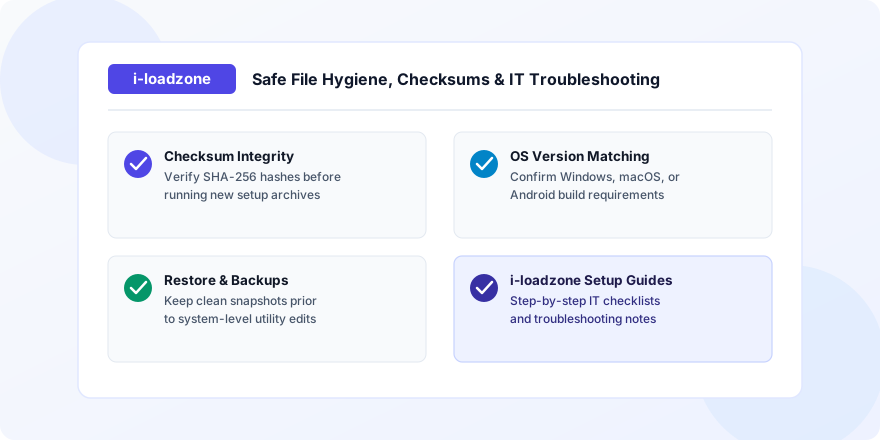
Safe File Hygiene, Checksums, and Pre-Installation Verification
Downloading utilities, drivers, and firmware tools safely requires healthy skepticism and a few seconds of verification before double-clicking any executable. Treating file hygiene as an automatic reflex protects both personal documents and studio hardware from corrupted transfers or unwanted adware bundles.
Why SHA-256 Checksums Matter for Every Archive
An interrupted transfer or mismatched mirror can flip bytes inside a large installer archive without producing obvious visual clues until an extraction error strikes halfway through setup. Computing a quick SHA-256 hash locally—using PowerShell’s built-in file hash cmdlet on Windows or `shasum` inside macOS Terminal—and comparing the string against published reference hashes confirms byte-for-byte integrity before running anything.
Reading Setup Wizards Carefully
Even legitimate freeware utilities occasionally bundle optional browser toolbars or third-party sponsor trials inside rapid "Next, Next, Finish" installers. Choosing custom or advanced installation views takes five extra seconds, lets you uncheck unneeded add-ons, confirms the exact destination folder path, and lets you decide whether desktop shortcuts or automatic startup helpers should be created.
Maintaining Clean Local Documentation
Keeping a concise troubleshooting notebook—either in a synced Markdown folder or printed inside a desk binder—multiplies the value of every problem you solve once. Recording exact error codes, which service restart fixed a printer queue, which driver build stabilized an audio interface, and where working backups reside guarantees you never spend an hour solving the exact same issue twice next year.
Building a Dependable Backup and Recovery Safety Net
No troubleshooting guide is complete without addressing recovery. Hardware drives age, power surges strike unexpectedly, and operating system upgrades occasionally conflict with older peripheral utilities. When a solid backup architecture sits quietly behind your workflow, system hiccups become minor scheduling detours rather than emergencies.
Combining System Checkpoints With Off-Device File Backups
Separate operating system recovery from personal data protection. On Windows, keeping System Restore enabled on your boot drive provides fast rollback for driver, registry, and utility tweaks. On macOS, local Time Machine snapshots let you revert individual folders or entire application states quickly. For actual documents, code projects, audio masters, and family photos, pair local external SSD backups with encrypted off-site cloud copies so no single failure affects all copies simultaneously.
Preparing a Portable Rescue USB Toolkit
Every multi-device household benefits from one clearly labeled USB flash drive holding essential offline recovery tools: a bootable Windows or Linux diagnostic environment, exported network and chipset drivers for your primary laptop, portable disk-health and memory-testing utilities, and plain-text copies of critical network credentials and setup notes. When a main PC refuses to boot on a Sunday night, having that rescue toolkit sitting in a desk drawer turns panic into calm repair.
Quarterly System Audits for Small Teams and Home Offices
Even well-configured computers accumulate subtle configuration drift over months of active client projects, browser extension trials, and seasonal operating system updates. Scheduling a calm twenty-minute audit once every ninety days keeps small studio networks, shared printers, and personal laptops running with first-day responsiveness without interrupting mid-week deadlines.
Begin your quarterly checklist by auditing startup applications and scheduled background helpers on Windows and macOS alike. Disable updater trays for software you only launch once a month, clear spent download installers after archiving essential packages safely, and verify that boot drives maintain at least fifteen to twenty percent unallocated capacity so virtual memory paging and solid-state wear leveling remain fast.
Next, verify peripheral and backup readiness together. Print a single alignment and nozzle check page on office inkjet printers, test a quick file restoration from your external backup SSD to confirm archive integrity, and double-check that your mobile two-factor authenticator recovery codes remain stored securely offline. Small, predictable maintenance sessions eliminate sudden Monday morning emergencies across every device on your desk.
Monitoring SSD Wear, Smart Health, and Battery Longevity
Hardware storage and lithium-ion batteries age gradually in the background, giving subtle early signals long before abrupt failure. Reading S.M.A.R.T. health counters once a quarter through lightweight disk diagnostic utilities reveals remaining solid-state drive spare blocks, unsafe shutdown counts, and sustained controller temperatures. If a laptop’s primary NVMe drive runs hot during prolonged video exports or shows rising media wear indicators, improving desk airflow and accelerating backup intervals protects irreplaceable project work ahead of time.
Battery care follows similarly practical principles. Laptops plugged into wall adapters continuously for months benefit from enabling manufacturer charge-threshold limits—such as capping maximum charge around eighty percent during stationary desk work—while keeping cooling vents free of lint so battery cells are never exposed to trapped heat.
Frequently Asked Questions About Cross-Platform Tech Maintenance
Why do identical tasks feel different on Windows compared to macOS?
Windows and macOS organize file permissions, window management, and application packaging differently. Windows favors modular desktop utilities and shared runtime libraries, whereas macOS relies heavily on self-contained app bundles and stricter Gatekeeper execution prompts. Once you pick cross-platform file formats and equivalent lightweight tools on both systems, switching back and forth becomes effortless.
What is the fastest fix when a Windows printer keeps showing offline?
Start by checking whether the printer and computer remain on the same Wi-Fi network band and whether the printer’s local IP address shifted after a router reboot. Restarting the Windows Print Spooler service, clearing stuck jobs from the spool folder, and binding the printer to a reserved IP address in your router settings fixes most recurring offline errors permanently.
How can I check if a downloaded installer archive is complete before opening it?
First verify that the file size matches the published listing and that compressed ZIP or 7Z archives pass an integrity test inside your archive manager. For critical system tools or firmware packages, generate a SHA-256 hash using your operating system’s built-in terminal command and confirm it matches the reference checksum.
Are portable desktop apps safer for quick testing than standard installers?
For lightweight utilities like text editors, file renamers, or disk analyzers, portable builds keep all settings inside a single folder without modifying system registry keys or adding startup helpers. That makes testing clean and removal as simple as deleting one folder—though you should still verify file hashes and sources before launching any executable.
How often should multi-device users clean caches and review startup apps?
Reviewing startup entries, clearing browser and installer caches, testing backup recovery, and inspecting printer test pages once every quarter takes around twenty minutes and prevents slow gradual degradation across Windows PCs, Macs, and Android phones alike.
How do I safely transfer large files between an Android phone and a Windows PC?
For full-resolution photos, podcasts, or multi-gigabyte video clips, use a direct USB data cable set to File Transfer (MTP) mode or a local Wi-Fi transfer utility over your private home router rather than messaging apps that compress media. Once the folder finishes copying onto your PC drive, confirm the file count and sizes match before clearing temporary phone storage.
Final Thoughts on Organized Multi-Device Computing
Great IT hygiene is built on steady, understandable habits rather than complicated jargon. By organizing software choices cleanly by operating system, favoring lean utilities that respect battery and memory, servicing office peripherals before problems pile up, verifying file integrity before installation, and keeping offline backups ready, your computers and phones remain fast partners in daily work. Clear technical guides make every device easier to understand—empowering you to spend less time fixing tools and more time getting meaningful projects done.
Whether you are configuring a fresh Windows laptop for remote work, coordinating media folders with a MacBook, adjusting mobile companion apps on Android, or troubleshooting an office printer queue on a busy weekday morning, consistent documentation pays off immediately. Treat your personal device stack as a living toolkit: remove unused software clutter periodically, record every fix that saves you time, and keep reliable backups within reach so technology always supports your focus calmly and predictably. That steady discipline helps both individual creators and small offices avoid costly downtime year after year.